Animals / Dogs

Peruvian Hairless Dog

History of occurrence

According to certain experts, this dog was introduced in Peru during the Chinese immigration, soon after the promulgation of the law abolishing the slavery of blacks by the President of Peru, Don Ramon Castilla. On the other hand, other searchers suppose that this dog comes from the African continent through the intermediary of nomads who arrived in America accompanied by their hairless dogs. Another possible explanation is that the presence of this dog would be due to the migration of men and their dogs from Asia to America through the Bering Strait. 

However, next to all these suppositions, there are certain proofs such as the representations which appear on ceramics of different pre-Inca civilisations (Vicus, Mochica, Chancay, Chancay under Tiahuanacoid influence, Chimu); in many cases the hairless dog has replaced the Puma, the snake or the falcon, this in particular and in a more evident way in the Chancay culture. As we can gather from the reproductions, the hairless dog appears during the pre-Inca archaeological periods, i.e. between the years 300BC and the years 1400 AC.

General form

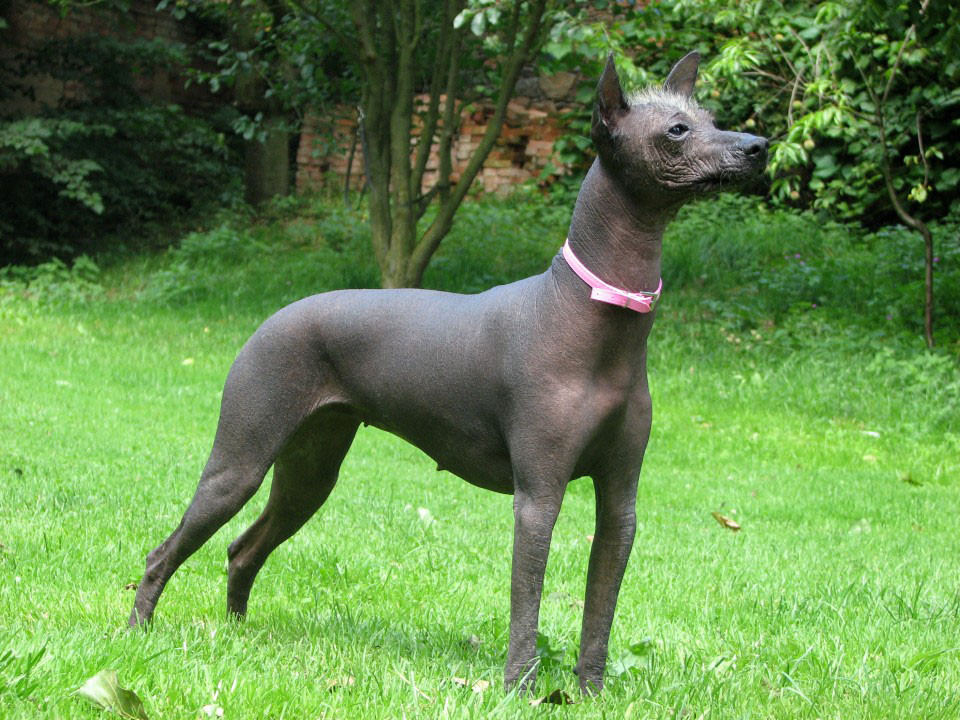
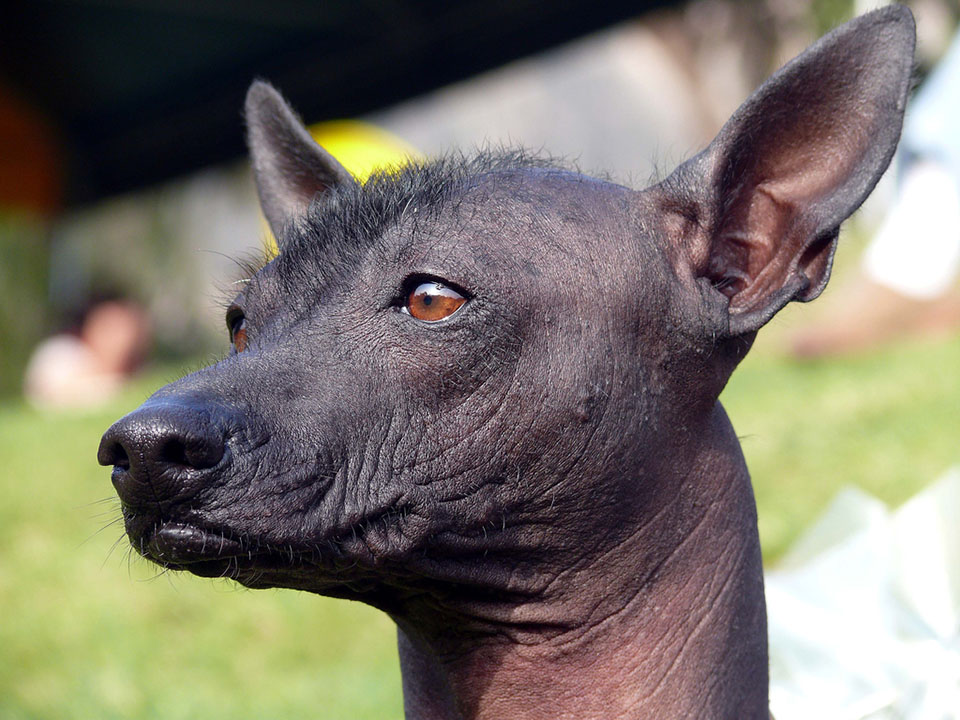
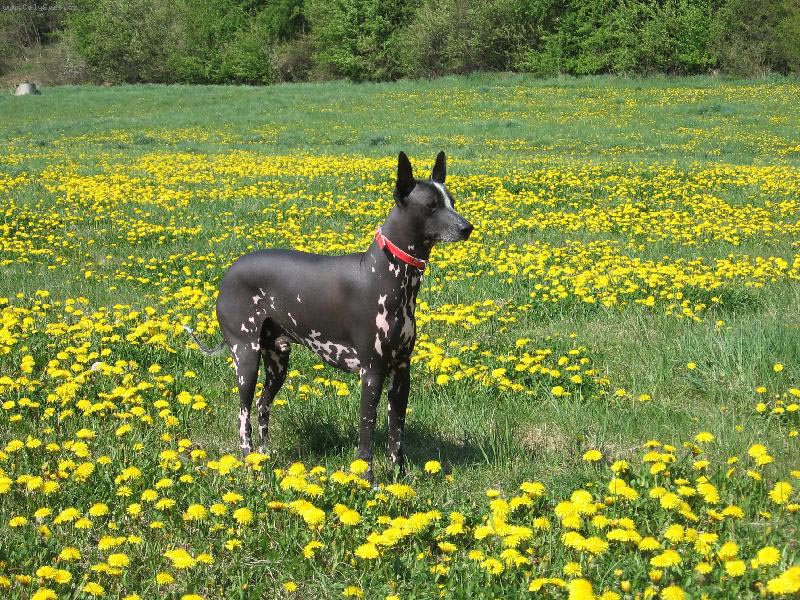
Going by his general conformation, it is an elegant and slim dog, whose aspect expresses speed, strength and harmony without ever appearing coarse. There are two varieties, the hairless whose main feature is the absence of hair all over the body and the coated variety, that is entirely coated. Another particular feature is that the dentition in the hairless variety is nearly always incomplete associated with the congenital alopecia.

Отличительная особенность породы Peruvian Hairless Dog

Head

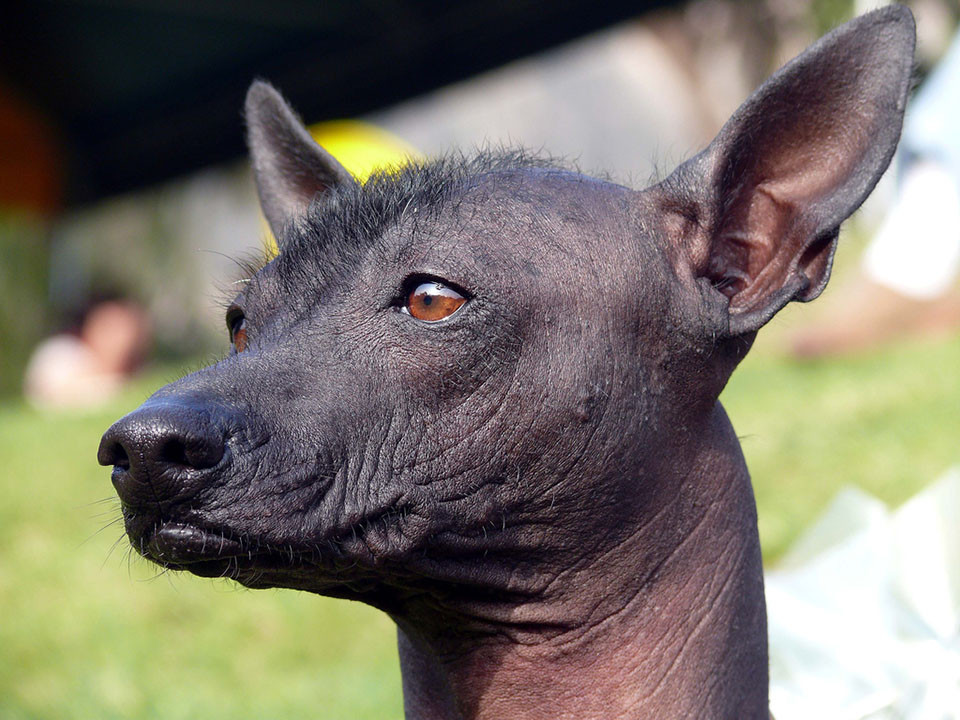
Skull: mesocephalic. Seen from above, the skull is broad and the head tapers toward the nose. The superciliary arches are moderately developed. The occipital crest is hardly marked.  Stop: slightly marked (approximately 140 degrees).  Nose: good pigmentation, the colour of the nose must be in harmony with the different colours of the skin; in the different shades in the hairless variety and with the colour of the hair in the coated variety.  Muzzle: seen in profile, the nasal bridge is straight.  Lips: they must be as tight as possible and close to the gums. 
Cheeks: Developed without exaggeration. Eyes: alert and intelligent expression. The eyes must be of average dimensions, slightly almond shaped, neither deep-set nor prominent, normally and regularly placed. i.e. neither too close together or too wide apart. The colour can vary from black, going through all shades of brown up to yellow, in harmony with the skin colour in the naked variety and with the coat in the variety with hair. In any case, both eyes must be of the same colour. The colour of the eyelids may go from black to pink in subjects with a light coloured face. The light pink colours are admitted but not sought after. The ears must be pricked when the dog is attentive, whereas at rest, they are laid towards the back. The ears are of medium length; broad at the base, tapering progressively towards their tip, ending almost pointed. The ear set starts on the upper part of the skull to end laterally and obliquely. In the erect position, the axes of the ears form a variable angle from 50 degrees to near 90 degrees. Jaws/teeth: the incisors should fit in scissor bite. In the hairless variety the absence of one or more teeth is accepted. In the coated variety the dentition must be complete with teeth normally developed and in a normal position. The jaw is not strongly developed.

Body

Neck: the upper line is curved (convex). The length is approximately the same length as the head. The shape is near to a truncated cone shape, supple, with good musculature. The skin on the neck is fine, smooth and elastic. Really close to the subcutaneous tissues. No dewlap. Body: muscular. Topline: level, although certain subjects show dorsal-lumbar convexity which disappears at croup level.  Chest: seen from the front, the chest must have a good amplitude, but without excess; come down almost to the elbow. Back: topline straight, with well-developed back muscles often forming all along the back a muscular bi-convexity which extends to the lumbar region.  Loin: strong and well muscled. Its length reaches approximately 1/5 of the height at the withers.  Croup: the superior profile is slightly convex, slanting approximately 40 degrees to the horizontal. Solid and well-muscled giving a good push.  Chest: seen from the front, the chest must have good amplitude, but without excess; reaching almost to the elbow. The ribs must be slightly sprung, never flat. The chest, measured behind the elbows, must exceed the height at the withers with approximately 18 percent.  Underline and belly: the lower profile presents an elegant and well-marked line which goes from the lower part of the chest and rises along the belly which must be well tucked up, but without excess.

Paws

Forequarters: well united with the body. Seen from the front, they are perfectly vertical and the elbows are not turned out. The angle at the shoulders joint varies from between 100 degrees and 120 degrees. Seen in profile, the angle formed by the pastern and the vertical will form 15 degrees to 20 degrees. Hindquarters: the muscles are rounded and elastic. The curve of the buttocks is well marked. The coxal-femoral (hips/thigh) angle varies between 120 degrees and 130 degrees. and the femoral-tibial (stifle) angle must be of 140 degrees. Seen from behind, the hindquarters must be vertical. Dewclaws must be removed. Forefeet:  are semi-long and look like hare-feet. The pads are strong and heat-resistant. The inter-digital membranes are well developed. The black dogs have preferably black nails and the lighter coloured dogs light nails.  Hind feet: same as forefeet.

Tail

The tail is set on low. Of good thickness at its root, it tapers towards its tip. When excited, the dog can carry the tail raised in a round curve above the backline, but never as curved as being rolled up. At rest, it hangs with a slight upward hook at the tip. Sometimes carried tucked in towards the abdomen. In length it almost reaches the hock. The tail must not be docked.

Wool

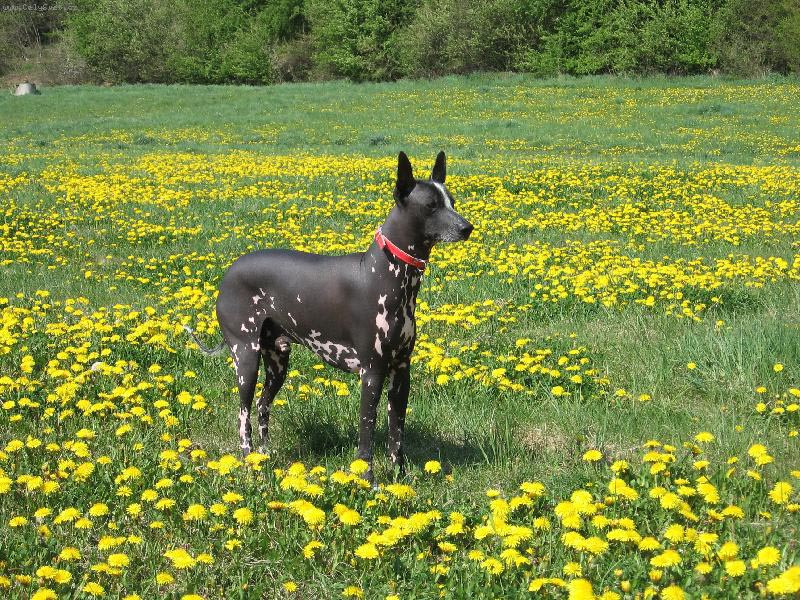
Hairless variety: without hair, only very few hairs on the head and at the extremities of the legs and the tail are admitted, and sometimes sparse hair on the back. These hairs can be any colour or combination of colours.  Coated variety: smooth, short and tight coat. The hair can be any colour or combination of colours. The skin must be smooth and elastic all over the body, but can form a few rounded almost concentric lines on the head and round the eyes and the cheeks in the hairless variety. It has been verified that the internal and external temperature of the hairless dogs is exactly the same as other breeds (coated or not). The absence of hair leads to an immediate and direct emanation of heat, different from the coated subjects, where the heat filters through the coat by natural ventilation. The colour of the skin in the hairless variety can vary from black, slate black, elephant black, bluish black, the whole scale of greys (diluted black), all nuances of genetic blue, dark brown going to light blond. All colours can be either uniform or show pinkish or white patches on all parts of the body. White or pink spots must not cover more than 1/3 of the body. Solid colours are preferred.

Movement

Due to the angulations defined at the description of the limbs, some of these dogs move with shorter steps but faster and at the same time quite soft and flexible. The limbs, seen from front or behind must move in a single line (i.e. single tracking).

Size

Height: Small: 25-40 cm. Medium: 40-50 cm. Large: 50-65 cm.

Weight: Small: 4-8 kg. Medium: 8-12 kg. Large: 12-25 kg.

Character

Noble and affectionate at home with those close to him, at the same time lively and alert; he might be wary of strangers and is a good watch dog.

Maintenance care

Hairless Peruvian Inca Orchids obviously don’t need to have their coats groomed, because they have no coats. However, they still need grooming. They should not go outdoors without sunscreen or a wrap of some sort, to provide protection from the sun or from chilly weather. Their skin should be wiped down with a warm, damp cloth every few days to remove dirt, dust and debris. Their skin also should be moisturized regularly with lotion or oil appropriate for use on dogs. The coated variety rarely sheds. However, its coat is prone to developing tangles and should be brushed regularly to keep it neat and tangle-free. Regular baths, with a very gentle shampoo, are important in both varieties of this breed. Ears, nails and teeth should be cared for as in any breed, with regular cleaning, clipping and brushing, respectively. Lifespan — 11-13 years.

Dignity

Plays well with other dogs and is easy to live with. They are loyal and affectionate to their family members and make excellent companions. These are sensitive dogs that are best suited for homes with adults and older children.   Mature PIOs are generally calm, quiet, smart and somewhat independent. They are devoted to their owners, reserved with strangers, but rarely aggressive.

Difficulty keeping

They don’t appreciate being left alone for long periods of time.

Diseases

While the breed is generally regarded as being healthy, its limited genetic diversity and hairlessness contribute to several health concerns. The genes responsible for hairlessness also affect dentition. Hairless PIOs usually are missing some of their teeth and are prone to other dental problems. Most of them are born without premolars, and some without molars, which can make it difficult for them to chew hard food. Some also are missing one or both of their canine teeth. The coated variety should have full dentition. Other breed health concerns include inflammatory bowel disease (IBD), dry skin, strokes and seizures. PIOs are especially sensitive to cold and to sunlight. The hairless variety is particularly predisposed to acne and sunburn and suffers disproportionately from physical contact with pesticides or other harmful toxins that are easily absorbed through bare skin.
Authentication required

You must log in to post a comment.

Log in
There are no comments yet.