Animals / Dogs

Tornjak

History of occurrence

The almost extinct descendants of genetically homogeneous, native archaic types of shepherd dogs have been the foundation stock for the re-creation of the breed “Tornjak”. The dogs belonging to the original stock had been dispersed in mountain areas of Bosnia and Herzegovina and Croatia and their surrounding valleys. The major historical dates are the years 1067 and 1374. Written documents from these periods mention the BosnianherzegovinianCroatian breed for the first time. The research about their historical and more recent existence and then a systematic salvation from extinction started simultaneously in Croatia and Bosnia and Herzegovina around 1972 and continuous pure blood breeding began in 1978. Nowadays, the breed population consists of numerous, purebred dogs selected during a series of generations dispersed throughout Bosnia and Herzegovina and Croatia.

General form

The Tornjak is a large and powerful dog, well proportioned and agile. The shape of the body is almost square. The bone is not light, but nevertheless not heavy nor coarse. He is strong, harmonious and well balanced when standing and moving. His coat is long and thick.

Отличительная особенность породы Tornjak

Head

Head: elongated. The ratio between the skull and the muzzle is 1:1. Cranial region: the upper lines of the skull and muzzle are divergent. Supra-orbital arches are slightly visible. The hind part of the skull is elongated but moderately wide. The area from supra-orbital arches to the occiput is flat. The occipital protuberance is very slight. Stop: slightly pronounced. Nose: large with sufficiently wide nostrils. Should have dark pigmentation. Pigmentation in harmony with the colour of the coat. Depigmentation is not allowed. Muzzle: rectangular. The bridge of the nose is perfectly straight. Lips: tight fitting with dark pigmentation. Jaws/teeth: jaws are very long and strong. Perfect scissor bite with full dentition. Eyes: almond shaped, close fitting lids, dark colour. Dark pigmentation on edges of eyelids. Ears: of medium size, triangular, folded and pendant, set rather high. Carried close to the cheeks. With shorter hair.

Body

Neck: of medium length, powerful, carried slightly low. Skin tight fitting. Long, abundant coat forming a mane.  Withers: moderately developed. Back: short, taut, moderately broad and straight.. Loin: connection between chest and croup is short and moderately broad; in females it is a bit longer. Croup: of medium length, broad and slightly sloping. Chest: very spacious, deep, broad and oval shaped. The lowest point of brisket reaches at least to the elbows. Never barrel shaped. Chest is strong, with moderately pronounced point of sternum. Underline: belly well muscled. The underline is not tucked up but gradually slopes up from the end of the sternum to the rear.

Paws

Limbs: strong and well angulated. Forequarters: General appearance: well developed, strong bones, tight muscles. Parallel and upright when standing. Shoulders: of medium length, well laid back. The scapularhumerus angle is about 120°. Upper arms: muscular and strong. Almost the same length as shoulders. Elbows: moderately close to the body. Forearms: strong bones, developed muscles, upright. Metacarpus (pastern): slightly sloping. Front feet: toes arched and tightly knit. Nails pigmented, dark pigmentation desirable. Resilient pads, hard and tight, dark pigmentation desirable. Front feet more developed than hind feet.  Hindquarters: General appearance: strong and parallel. Upright when standing with adequate angulation. Knee well bent. Upper thighs: broad, strong, well muscled. Lower thighs: well muscled, strong, broad, of the same length as the upper thigh. Hocks: firm, set a bit high. Metatarsus (Rear pastern): strong. Possible existence of dewclaws. Hind feet: toes arched and tightly knit. Nails pigmented, dark pigmentation desirable. Resilient pads, hard and tight, dark pigmentation desirable.

Tail

Long, set at medium height, very mobile. When relaxed it is hanging and in movement it is always raised over the level of the back, which is characteristic of the breed. Abundantly coated with distinct plume.

Wool

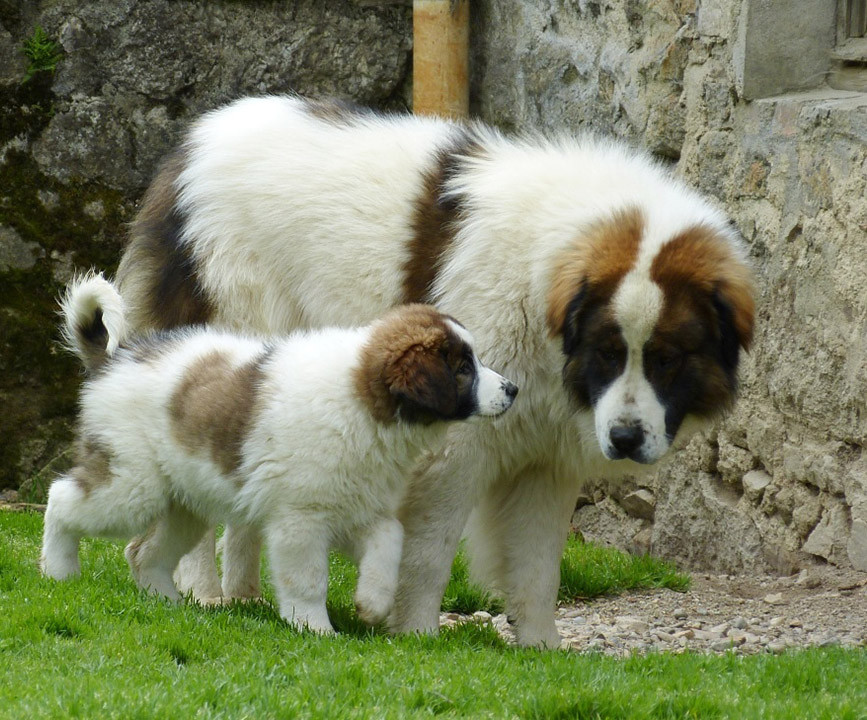
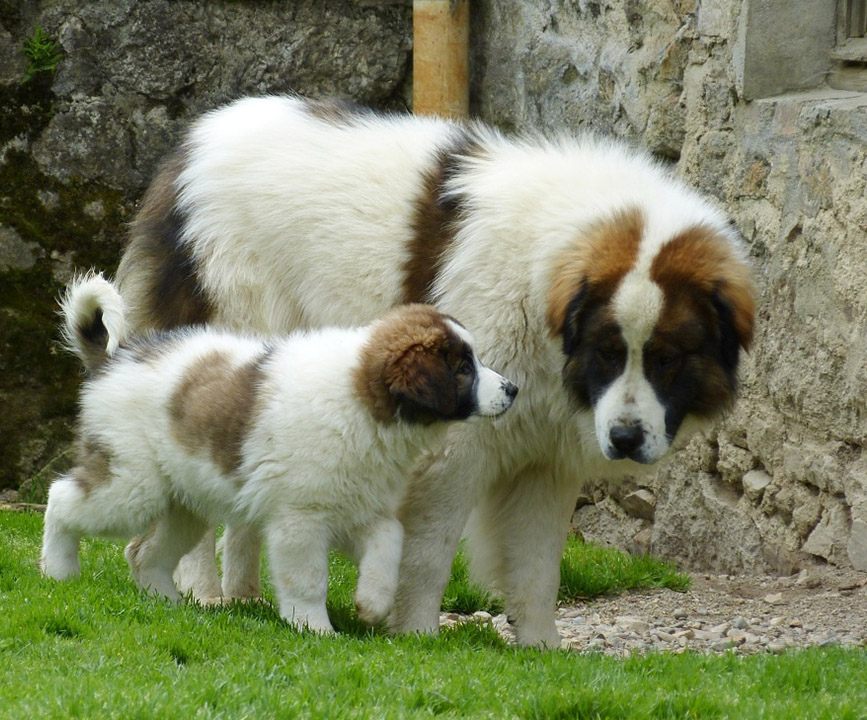
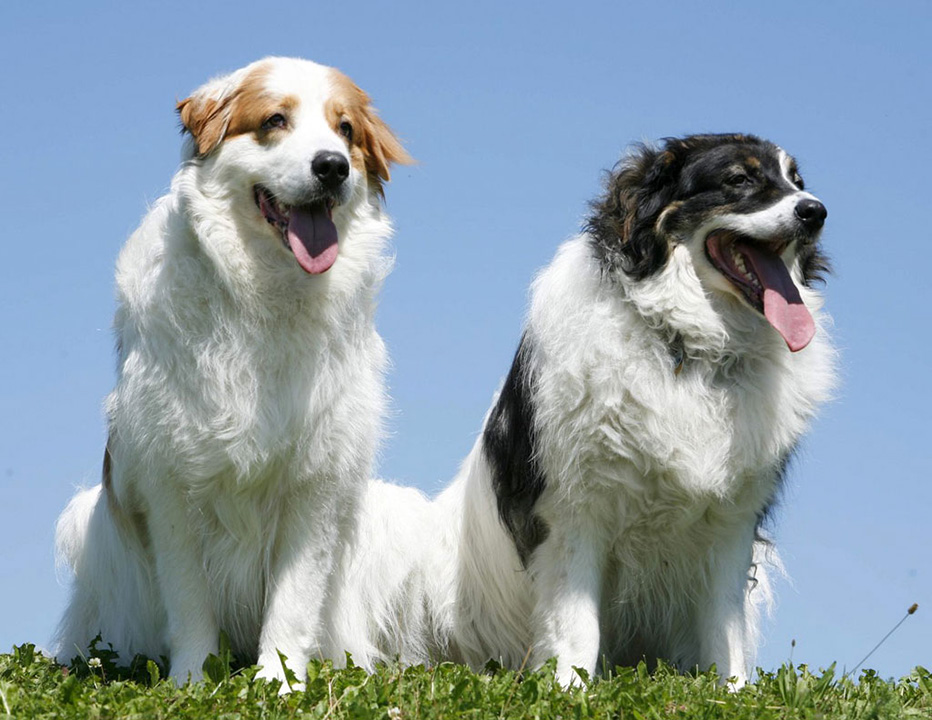
Skin: thick, well fitting all over the body. Hair: in general, the Tornjak is a long coated dog with short hair over the face and legs. The topcoat is long, thick, coarse and straight. It is specially long on the upper part of the croup; over the shoulders and the back it can also be slightly wavy. On the muzzle and the forehead, up to the imaginary line connecting the ears, over the ears and on the front parts of legs and feet it is short. It is especially abundant around the neck (mane), dense and long over the upper thighs (breeches). It forms feathers along the forearms. With well coated dogs it is also especially abundant on the rear of hind pasterns. The tail is richly coated with very long hair. Winter undercoat is long, very thick and of nice woolly texture. Hair is thick and dense and should not part along the back. Colour: as a rule the Tornjak is parti-coloured with distinct markings of various solid colours.Usually the dominant ground colour is white. There may be dogs with a black mantle and with white markings most often found around the neck, over the head and along the legs. There may also be almost white dogs with only small markings.

Movement

The Tornjak is a trotter. Movement is well balanced, supple, long reaching, harmonious, with strong drive from hindquarters. In movement the backline is firm.

Size

Height at withers: Dogs — 65-70 cm. Bitches — 60-65 cm.

Character

Of steady disposition, friendly, courageous, obedient, intelligent, full of dignity and self confidence. Fierce in guarding property entrusted to him, cannot be bribed and is suspicious of strangers. Devoted to his master and very calm in his presence. Very affectionate towards persons living in his immediate vicinity. Learns quickly and keeps this in his memory for a long time, gladly performs tasks assigned to him. He is easy to train.

Maintenance care

The Tornjak is not very demanding in terms of exercise – he will do well with a long daily walk and plenty of play time, especially with other dogs. The Tornjak is most commonly used for herding and protecting livestock, so he can be trained for either of these purposes. This breed is intelligent and decisive so a firm and consistent hand in training is recommended to keep the dog from becoming willful. Tornjaks are quick to learn and they do not forget things quickly, so you are only likely to need a few repetitions when training. Lifespan — 12-14 years.

Dignity

The Tornjaks are rather good with children and family members if socialized with care in early ages.  The Tornjaks is a cordial, fearless, quiet, intelligent, courageous, and self-determined and fully greatness.  The Tornjaks stands hardy and strong in snowy seasons night; even these dogs can lie in snow for hours.  The Tornjaks is easy to train.

Difficulty keeping

The dogs outer coat is long, straight and hard while under coat is fully and dense.

Diseases

The Tornjak is a healthy breed in general, though too much protein in the diet has been known to cause certain health problems, especially with the coat. It is also worth noting that climbing stairs and other forms of strenuous exercise should be avoided during the first 6 months of age to avoid joint problems and the development of hip dysplasia.
Authentication required

You must log in to post a comment.

Log in
There are no comments yet.